What are Islamic geometric patterns?
4 min read · Updated
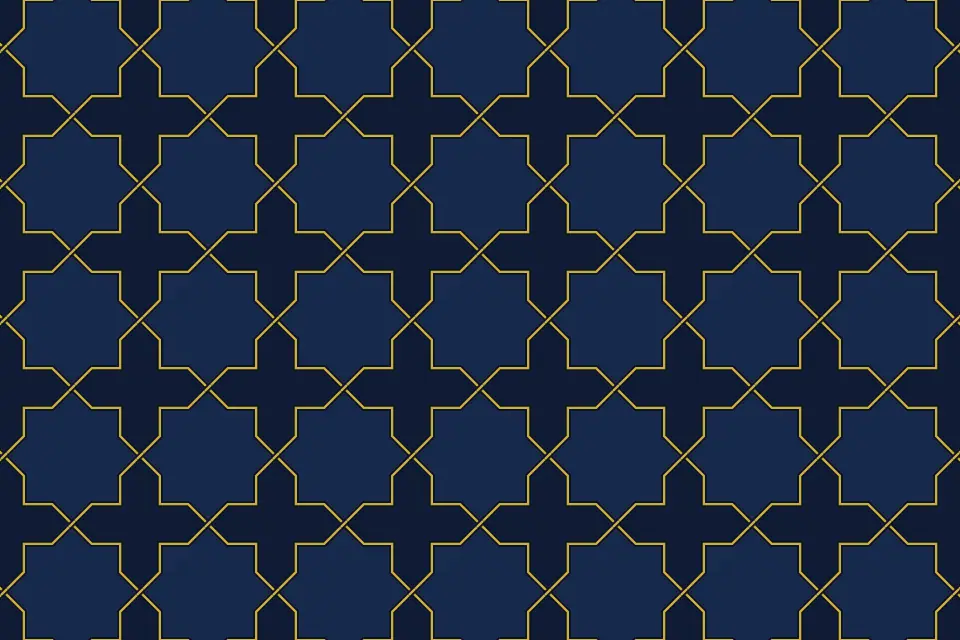
Islamic geometric patterns are designs built from stars, polygons and interlacing lines that repeat across a surface in a regular way. Together with vegetal ornament (often called arabesque) and calligraphy, geometry is one of the three main kinds of ornament found across the art of the Islamic world, from Spain and Morocco to Central Asia and India.
What they are made of
Most patterns are built from a few simple ingredients: a circle divided into equal parts, the straight lines that join those divisions, and a grid on which the resulting motif repeats. The motifs are usually named by their symmetry (six-, eight-, ten-, twelve- and sixteen-point stars are all common), and the spaces between stars become secondary shapes such as crosses, kites and hexagons.
Because the motif sits on a regular grid, a pattern can in principle continue forever in every direction. The edge of a panel simply cuts through it, which is why many patterns look as if they extend beyond the wall.
Where they appear
Geometric ornament appears on almost every material: cut-tile mosaic, glazed tiles, carved stucco and stone, brickwork, inlaid and carved wood, metalwork, book bindings and the illuminated pages of manuscripts. Well-known examples include the tile dadoes of the Alhambra in Granada, the carved wooden doors and minbars of Mamluk Cairo and the brick and tile buildings of Iran and Central Asia.
Geometry became especially prominent from around the tenth and eleventh centuries onward, and the patterns grew more complex in the centuries that followed.
How craftsmen drew them
Historical patterns were drawn with a straightedge and compass. A few working drawings survive, the best known being the Topkapı Scroll, a roll of architectural and ornamental designs probably made in Iran in the late fifteenth or early sixteenth century. Its drawings show the construction lines that guided the craftsman, though the exact workshop methods were rarely written down.
Modern researchers have proposed several methods that reproduce the historical patterns. One of the most useful is the “polygons in contact” method described by E. H. Hankin in the 1920s, in which stars grow from the midpoints of the edges of a tiling of polygons. Another line of research found that some later Iranian patterns were laid out with a small set of decorated tiles, sometimes called girih tiles.
Why they matter today
These patterns are still made by craftsmen in Morocco, Egypt, Syria, Turkey, Iran, Pakistan and beyond, and they are widely used by designers today: in architecture, packaging, textiles, book covers and digital graphics. They offer a visual language that is rooted in a long tradition and yet contains no figurative images or text, which makes them easy to use respectfully in many settings.
Sources
- The Metropolitan Museum of Art, “Geometric Patterns in Islamic Art”, Heilbrunn Timeline of Art History (2001). metmuseum.org/toah/hd/geom/hd_geom.htm
- Eric Broug, Islamic Geometric Patterns. London: Thames & Hudson, 2008.
- Jay Bonner, Islamic Geometric Patterns: Their Historical Development and Traditional Methods of Construction. New York: Springer, 2017.
- Gülru Necipoğlu, The Topkapı Scroll: Geometry and Ornament in Islamic Architecture. Santa Monica: Getty Center, 1995.
- Peter J. Lu and Paul J. Steinhardt, “Decagonal and Quasi-Crystalline Tilings in Medieval Islamic Architecture”, Science 315 (2007): 1106–1110.
- Keith Critchlow, Islamic Patterns: An Analytical and Cosmological Approach. London: Thames & Hudson, 1976.